You Can Get There from Here
In our house, you would be in trouble for not putting your plate in the dishwasher. In our house, you would be in big trouble for traipsing across the kitchen floor in dirty work boots. In our house, you would risk something close to excommunication if you left a wet towel on the bed!
All homes have house rules and regulations. The rules may be a little more relaxed if you live by yourself, nevertheless, rules learned from your parents become self-imposed rules that help life run a little more smoothly.
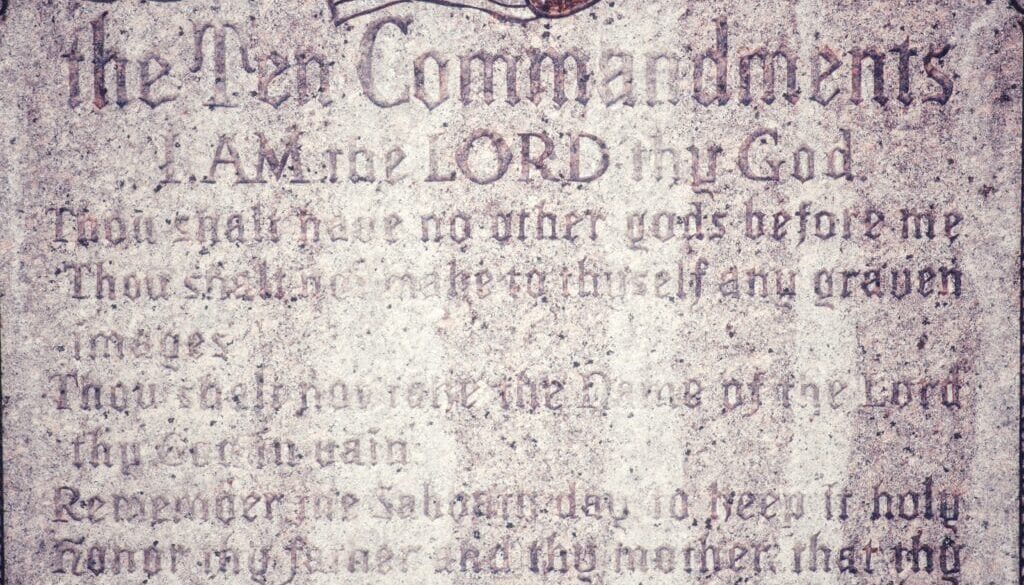
The same is true in society. There are rules and regulations, only we call them laws. They serve a similar purpose: to ensure an orderly and harmonious way of living together, and to safeguard respect, fairness, and equality for everyone. About three thousand years ago, Moses received the moral law from God in the form of the Ten Commandments. These commandments were not meant to be a burden but a gift. They are traditionally divided into two parts: the first three commandments guide our relationship with God, and the remaining seven govern how we are to treat one another. From this, an important question naturally arises: What is to be gained by keeping these commandments? We know what comes from obeying the rules of our home—a cleaner house and fewer arguments. We know what comes from obeying the laws of society—a more peaceful and just community. So, what do the Ten Commandments ultimately give us?
Some years ago, a business expert wrote a compelling book about the seven main habits of successful people. The book sold millions. In the book, the author identified patterns of behavior common to people who tend to succeed in life. One reason the book resonated so deeply is that the principles described align with human nature—they simply make sense. The second habit described is this: Begin with the end in mind. We actually do this quite a bit. When we get into a car, we make our first turn based on where we intend to end up. When we choose a career, we select our path of education with a vision of fulfilling that purpose. So what about life itself? How often do we consciously think about the final destination of our lives? Every morning when we step out of bed, we stand one day closer to our eternal destination and Jesus invites us to live each day with Heaven as our goal.
The commandments are not outdated rules; they are a roadmap pointing us toward both the life for which we are created and the destination in which we are heading. To get there, Jesus asks us to look deeply at our hearts. It is not enough to say we have not killed, if we harbor anger. It is not enough to say we are faithful, if our thoughts betray that commitment. It is not enough to say we have not stolen, if we deprive others of dignity or fairness.
Each new day becomes a fresh invitation to live with the end in mind. Heaven may seem distant at this time but as we continue on our journey, by following the commandments, we will know that our moral compass is pointing in the right direction.
The good news is this: God never asks us to walk this path alone. Grace accompanies every commandment and, in the confessional, mercy meets us every time we fall short. When we strive to live God’s law out of love, we begin to experience a foretaste of Heaven even now. Our homes become more peaceful, our communities more just, our hearts more free. God’s law is not a limitation—it is an invitation—an invitation to become who we were created to be, and to walk confidently toward the joy that awaits us.
If we truly begin with the end in mind and trust God enough to follow the path set before us, we will, one day, discover that the rules were never about restriction at all—but about offering a road map to get us back home to our Lord and Savior, Jesus Christ.

Deacon Brendan Brides , a native of Ireland, was educated by the Presentation Brothers in Cork City, Ireland. Deacon Brendan emigrated to the United States in 1986. Shortly thereafter, he met his wife, Gail. They married in the early nineties and have resided in Sandwich ever since. They have a son, Patrick, who grew up attending religious education and serving as an altar server for many years at Christ The King Parish. Patrick now serves in the United States Navy. Deacon Brendan worked for many years as a building contractor on Cape Cod where he oversaw the construction of many fine houses in his career. In 2013 he decided to accept a position as building commissioner for a local municipality. He continues in that position today.
After his ordination by Bishop Coleman to the permanent diaconate in 2013, Brendan was transferred to Saint Johns in Pocasset. He spent six and a half years there serving the people of Bourne. He and his wife Gail returned to Christ the King in 2021 and although they sincerely miss the great people of Saint Johns, they are very happy to be back at their home parish of Christ the King. Besides being active at Christ the King, Deacon Brendan is currently a mentor for gentleman that is going through the permanent deacon program and he is also actively involved in assessing the latest class of applicants to the permanent diaconate for the Diocese of Fall River.