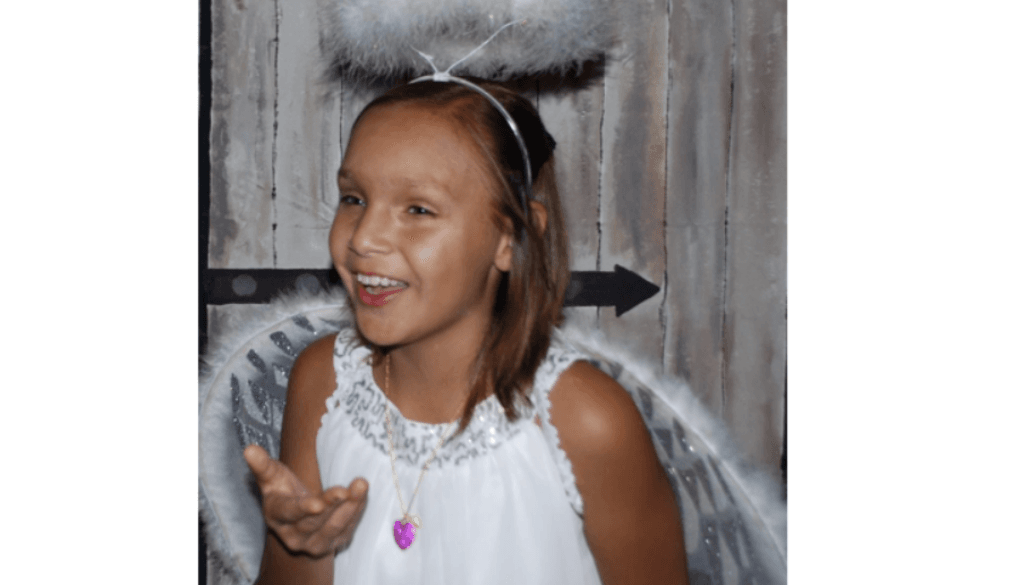
Eight Years of New Life with Christina Dangond — A Sign Pointing Us to Heaven
Eight years have passed since the death of Christina Dangond, yet what remains is not simply memory shaped by time, but life transformed by grace. Grace has a way of doing what time alone cannot: it does not erase grief, but it deepens it into meaning; it does not dull loss but opens it toward hope. In these eight years, the sorrow surrounding Christina’s death has not disappeared, but it has been gathered up, purified, and quietly reshaped by God into something new. What endures is not only love for Christina, but the grace that continues to flow through her life—a grace that still speaks, still teaches, and still points us beyond itself.
Christina was only eleven years old when she died. Her life, by the world’s standards, was painfully brief. And yet, in those years—especially in the final ones marked by illness—her life took on a clarity and depth that many never reach. She did not explain suffering. She did not solve the mystery of pain. But she pointed us somewhere while standing firmly within it.
A sign does not exist for itself. It does not ask us to stop and admire it. A sign directs the eye, the heart, the traveler toward something beyond. In the Christian imagination, a holy life functions this way: transparent, directional, quietly luminous. Christina’s life—so full of color, joy, trust, and childlike faith—became such a sign, pointing not to herself, but to heaven.
Even in illness, Christina resisted darkness—not by denial, but by presence. She lived with a remarkable attentiveness to the moment. She did not wait for healing to begin living. She did not postpone joy until suffering ended. Whether returning from long hospital treatments or enduring exhausting days of chemotherapy, she insisted on doing her homework, engaging life, greeting the day as gift. In this, she taught something profoundly theological without ever using theological language: God is found in the present moment.
There are many beautiful stories within Christina’s life. One of my favorites remains the following. Monica, Christina’s mother, once asked her, “Christina, what would be a perfect day for you?” Monica imagined that Christina might say, “When I have no more cancer,” or “When my chemotherapy treatments stop,” or perhaps, “When I get my hair back.” Christina, however, paused and reflected on the question. Instead of offering any of these answers, she said, “The perfect day would be when I truly know that I have done perfectly all that God has asked me to do on that day.”
Perhaps the clearest sign Christina offered was her extraordinary trust. If there was a prayer that shaped her young heart, it was simple and unwavering: Jesus, I trust in you. Those words—Jesús, en ti confío—became more than a phrase. They became her posture before God. She did not wrestle with God in fear; she clung to Him in surrender.
At one point, she asked her mother if she could add a prayer to her daily prayers. When asked what she wanted to say, Christina responded, “I want to tell God that He can do whatever He wants with my life.” Few adults arrive at such surrender after a lifetime of faith. Christina arrived there as a child. In her, trust was not resignation—it was freedom.
Eight years later, many still ask the same questions that were asked then: Why? Why such suffering? Why such loss?Christianity does not offer easy answers to these questions. What it offers instead is presence—and promise. The promise that suffering is not empty. The promise that love is stronger than death. The promise that heaven is not distant when God is trusted completely.
Christina did not become a sign because she died young. She became a sign because she lived faithfully. Because she trusted without conditions. Because she accepted each day as gift. Because she showed that holiness is not measured by years, but by love.
Christina still points us home.
Eight years later, we do not merely remember Christina. We follow where she pointed. Her life—brief, luminous, and surrendered—continues to direct our gaze beyond what is seen, beyond what can be explained, toward the promise of heaven that drew her so naturally.
She remains for us a sign: not holding our attention but lifting it. Not drawing us inward, but upward. And as we look where she pointed, we find ourselves standing in awe before a mystery greater than loss, greater than suffering, greater even than death itself.
And so, we end not with answers, but with praise—with the song that once accompanied our farewell, and now accompanies our hope:
“And His glory appears
like the light from the sun
Age to age He shines
Oh, look to the skies
hear the angels cry
Singing, “Holy is the Lord”
Eight years later, I can also speak personally of the fruits I have seen through Christina’s intercession in heaven. Through her witness, my own understanding of priesthood has deepened less as something to manage, more as something to surrender. The “Boston” Holy Family Institute itself, which would never have come together without the grace flowing from her life, continues to grow, opening doors to greater holiness in family life. Our annual Damascus men’s and women’s retreats have endured and borne fruit, drawing hearts back to God. And the nonprofit Build the Faith has expanded its mission, helping to build churches and retreat houses in economically depressed regions across the world. These are not achievements—they are gifts.
Christina, we love you!
Fr. Michael Harrington, a native of Swampscott, MA, is a Catholic Priest for the Archdiocese of Boston, and Currently the Pastor of St. Mary’s of the Annunciation Catholic Church in Cambridge. In the past he served as The Director of the Office of Cultural Diversity for the Archidiocese of Boston and is currently a Consecrated member of the Institute of Jesus the Priest (the Pauline Family).